
OSPF Summarization
In this lesson, you will learn how OSPF route summarization improves scalability by reducing the number of prefixes advertised between areas and limiting the impact of topology changes.
The article explains inter-area summarization on Area Border Routers, external-route summarization on Autonomous System Boundary Routers, configuration requirements, metric behavior, verification commands, and common troubleshooting issues.
Table of Contents
Why OSPF Summarization Is Used
Scalability is an important consideration in any routing protocol. OSPF divides a routing domain into areas so that every router does not need to maintain detailed topology information for the entire network.
Route summarization provides another level of scalability by replacing multiple specific prefixes with one aggregate route.
The primary benefits include:
- Smaller routing tables
- Fewer Type 3 or Type 5 LSAs advertised into other areas
- Reduced propagation of topology changes
- More stable routing information outside the affected area
- Simpler route-policy and troubleshooting views
- Better hierarchical network design
Summarization does not stop SPF calculations inside the area where a topology change occurs. Its main benefit is that the detailed change may not need to be advertised beyond the summarization boundary.
Where OSPF Summarization Occurs
OSPF routers inside the same area must maintain an identical link-state database for that area. Therefore, routes cannot be summarized arbitrarily by an internal router inside the area.
OSPF summarization normally occurs at routing-domain boundaries:
- ABR: Summarizes routes when advertising prefixes between OSPF areas.
- ASBR: Summarizes external routes that have been redistributed into OSPF.
An ABR uses the area range command for inter-area summarization. An ASBR uses the summary-address command for redistributed external routes.
Topology Without Summarization
The following topology contains several networks in Area 1 and a connection from Area 1 toward Area 0.
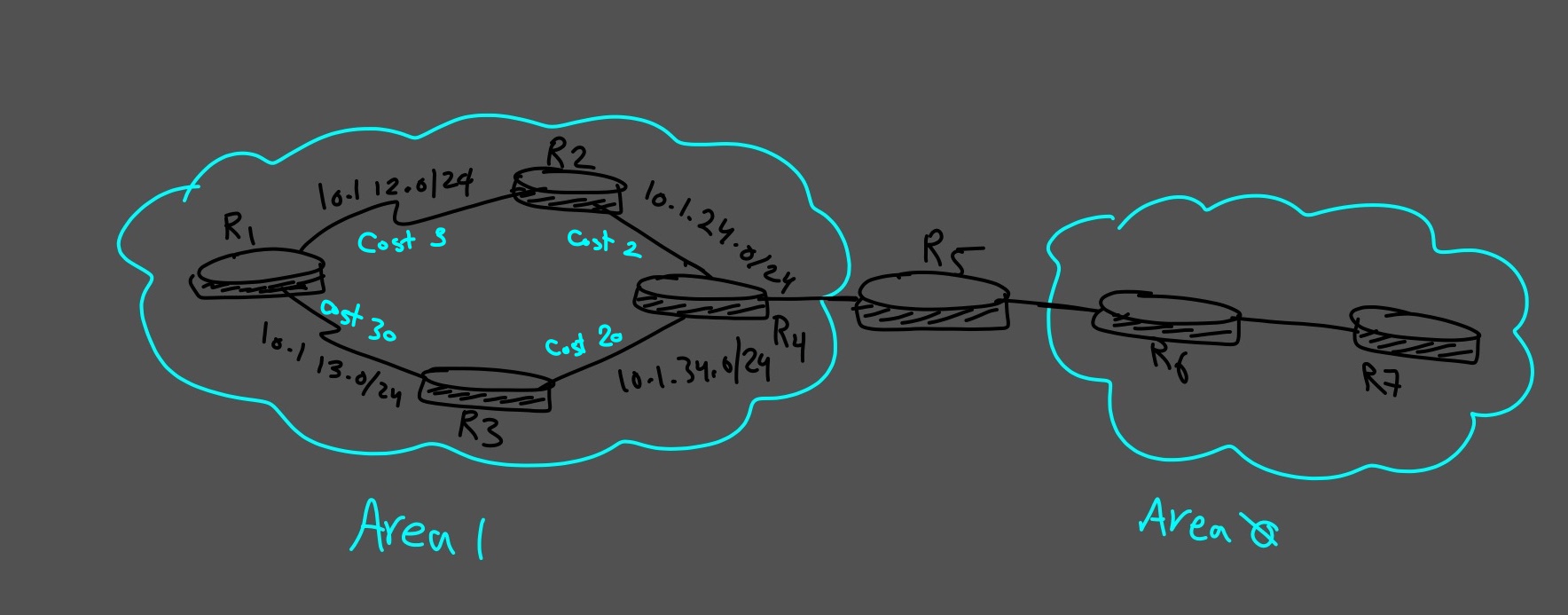
Based on the OSPF costs in this topology, traffic uses the preferred path toward R2 to reach Area 0.
Assume the link between R1 and R2 fails:
- The routers in Area 1 receive the related LSA update.
- The Area 1 link-state database changes.
- The affected routers run SPF again.
- The ABR recalculates reachability for the affected prefixes.
- Updated Type 3 LSAs may be generated for Area 0.
- Routers in Area 0 process the changed inter-area routing information.
Without summarization, multiple individual prefixes can be updated and advertised across the area boundary.
Topology With Summarization
In the next topology, the networks inside Area 1 are summarized by the ABR before they are advertised into Area 0.
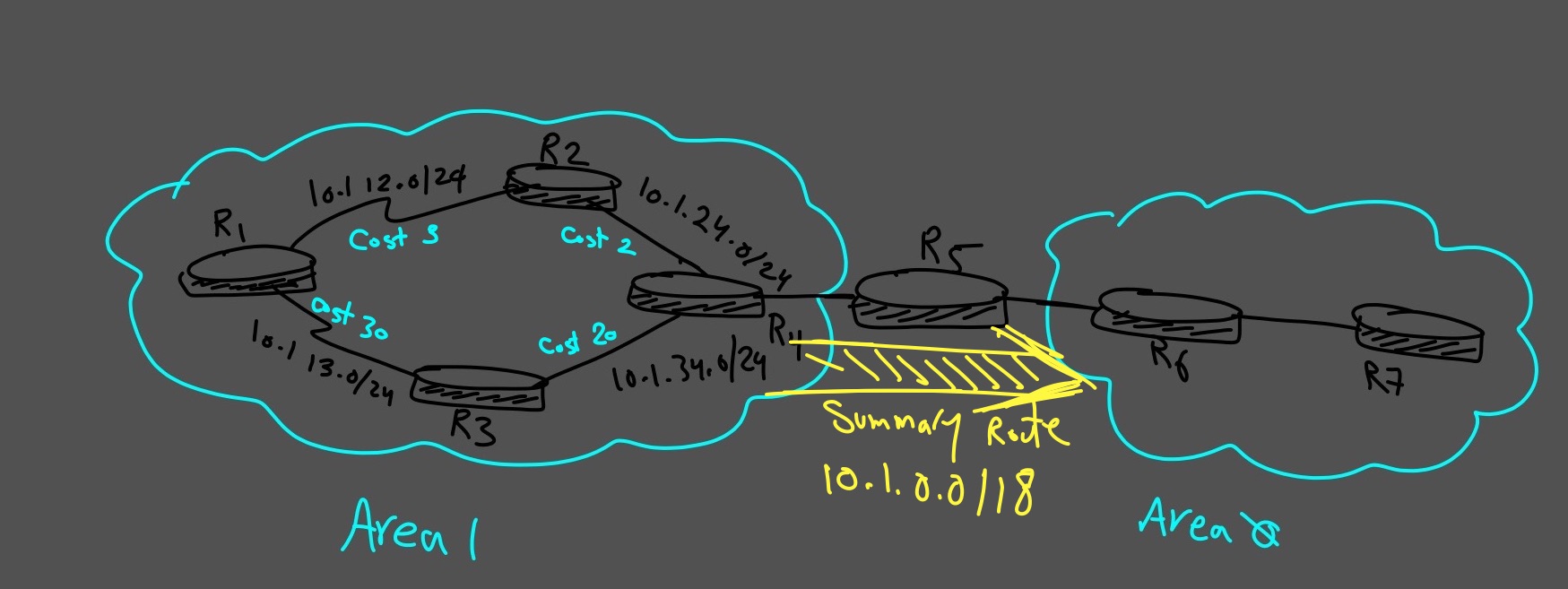
If the R1-to-R2 link fails, the routers inside Area 1 still process the topology change and run SPF as required.
However, if at least one component route belonging to the summary remains reachable, the ABR can continue advertising the same summary route into Area 0.
As a result, routers in Area 0 do not need to receive an update for every individual Area 1 prefix.
This limits the scope of the routing change, but it does not completely isolate Area 0 from every possible failure. If all component prefixes disappear and the summary is withdrawn, the change will still be advertised.
Inter-Area Summarization
Inter-area summarization is performed on an ABR. It combines multiple routes from one area into a summary advertised toward another area.
The Cisco IOS configuration format is:
router ospf <process-id>
 area <source-area-id> range <summary-network> <summary-mask>
The area number identifies the area containing the component routes being summarized.
Example
Assume Area 1 contains these networks:
10.1.0.0/2410.1.1.0/2410.1.2.0/2410.1.3.0/24
They can be summarized as 10.1.0.0/22:
router ospf 1
 area 1 range 10.1.0.0 255.255.252.0
The ABR advertises the summary as a Type 3 Summary LSA toward the other area.
Suppressing Advertisement
A range can also be configured with the not-advertise option when the matching routes should not be advertised into other areas:
router ospf 1
 area 1 range 10.1.0.0 255.255.252.0 not-advertise
This suppresses the matching inter-area route advertisement rather than creating a visible summary.
External-Route Summarization
External-route summarization is performed on the ASBR that redistributes routes into OSPF.
The Cisco IOS configuration format is:
router ospf <process-id>
 summary-address <summary-network> <summary-mask>
Example
Assume the ASBR redistributes these routes:
172.16.0.0/24172.16.1.0/24172.16.2.0/24172.16.3.0/24
They can be summarized as:
router ospf 1
 summary-address 172.16.0.0 255.255.252.0
The ASBR advertises the aggregate instead of advertising every matching external prefix separately.
Depending on the area type and translation behavior, external routing information can appear as Type 5 LSAs or as Type 7 LSAs inside an NSSA before translation by an ABR.
Address-Planning Requirements
Effective summarization depends on a structured IP addressing plan.
Prefixes should be assigned so that networks belonging to the same site, area, service, or routing boundary fall into contiguous address blocks.
Good summarization design requires:
- Contiguous component prefixes
- Correct summary mask calculation
- No unintended networks inside the aggregate range
- Clear alignment between address blocks and OSPF areas
- Consistent configuration on redundant ABRs
- Awareness of possible black-hole conditions
A broad summary that includes unallocated or unreachable subnets can attract traffic toward the ABR even when no valid component route exists for the destination.
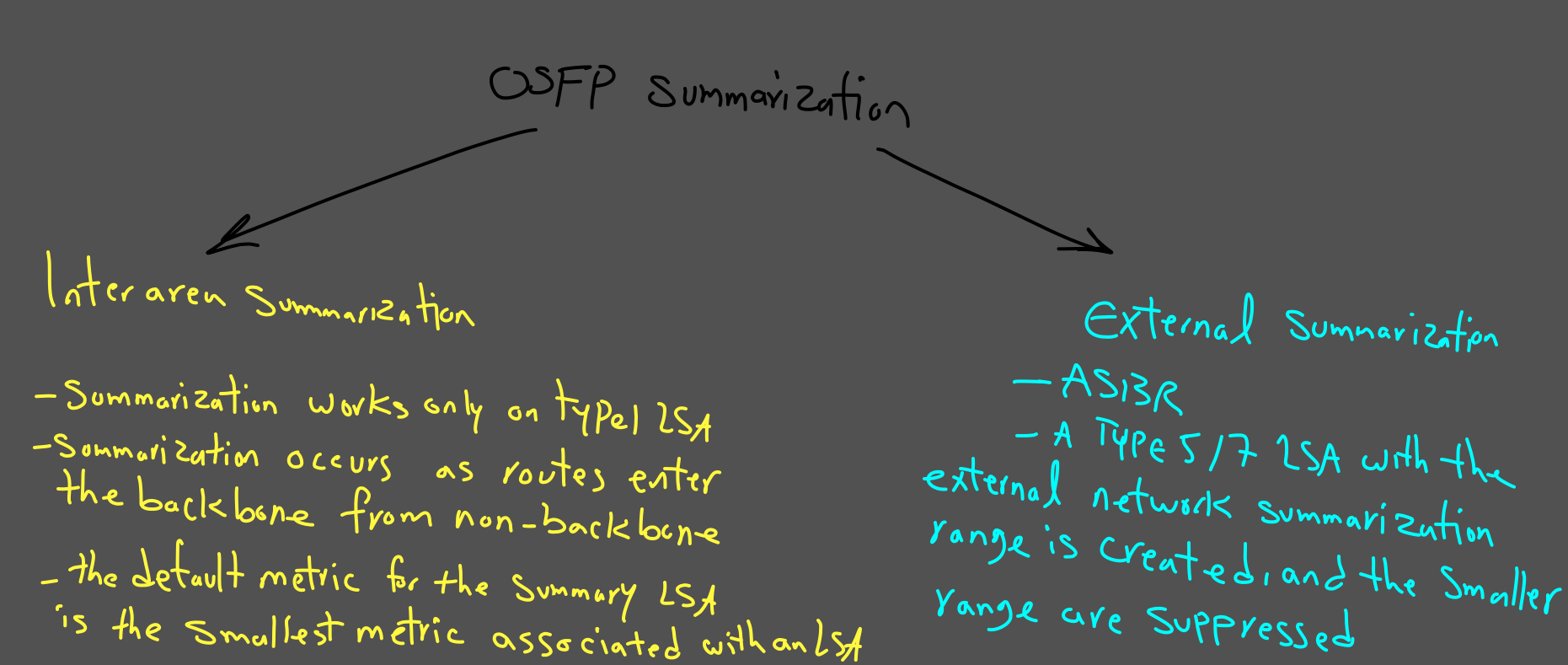
The following diagram provides an overview of the OSPF summarization design:
Configuration
Inter-Area Summary on an ABR
router ospf 1
 area 1 range 10.1.0.0 255.255.252.0
External Summary on an ASBR
router ospf 1
 summary-address 172.16.0.0 255.255.252.0
Optional Explicit Summary Cost
On supported Cisco platforms, the summary can be configured with an explicit cost:
router ospf 1
 area 1 range 10.1.0.0 255.255.252.0 cost 50
Without an explicit configured value, the summary metric is derived from the matching component routes according to the platform’s OSPF implementation.
Video Demonstration
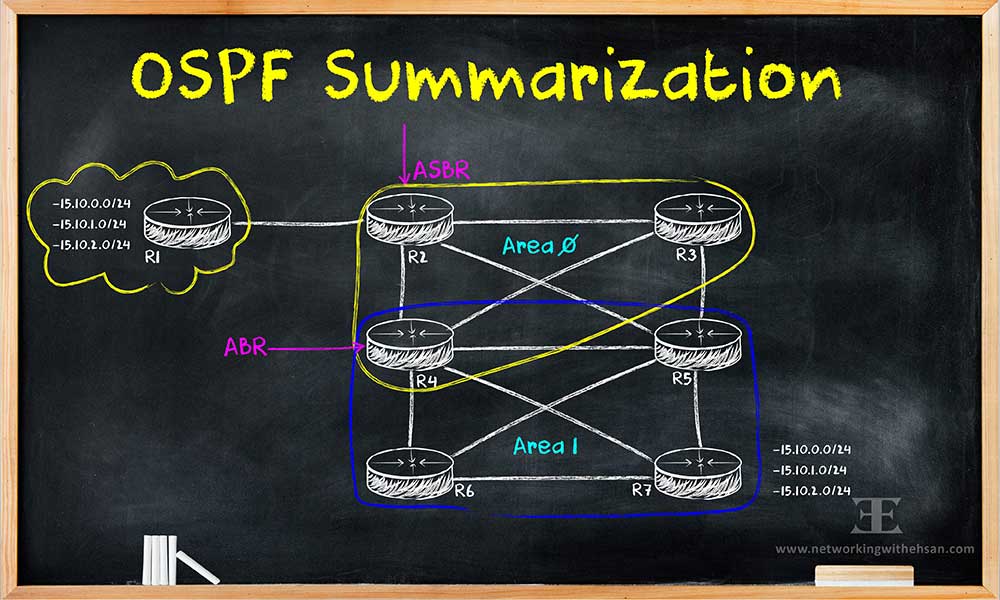
The following video demonstrates inter-area and external OSPF summarization, configuration, and verification.
The lab topology used in the video is shown below:
Verification
Check the OSPF Routing Table
show ip route ospfConfirm that routers outside the source area receive the summary instead of all component routes.
Check a Specific Summary
show ip route <summary-prefix>Verify the next hop, outgoing interface, administrative distance, metric, and route source.
Check the OSPF Database
show ip ospf database summary
show ip ospf database external
show ip ospf database nssa-external
Use the appropriate command for the type of route being summarized.
Check the ABR Configuration
show running-config | section router ospf
show ip ospf
Confirm that the correct area ID, network, mask, and optional cost are configured.
Verify Component Routes
The ABR or ASBR must have at least one matching component route before it can normally advertise the summary.
show ip route <component-prefix>
show ip ospf rib
Test Failure Behavior
- Record the routing and LSDB state before the failure.
- Disable a link affecting one component route.
- Verify SPF activity inside the source area.
- Confirm whether the summary remains advertised.
- Check whether routers in the other area receive an LSA update.
- Restore the link and confirm convergence.
Summary Discard Route
When an OSPF summary is generated, the summarizing router commonly installs a route for the aggregate pointing to Null0.
This discard route helps prevent routing loops. Traffic matching the summary but not matching a more-specific reachable route is discarded locally rather than being forwarded back toward another router.
A typical route-table entry can appear similar to:
O 10.1.0.0/22 is a summary, Null0The exact output varies by Cisco platform and software release.
The Null0 route is an intentional protection mechanism. It also demonstrates why summaries must be designed carefully: traffic for nonexistent subnets inside the aggregate can be discarded by the summarizing router.
Troubleshooting
The Summary Is Not Advertised
- Confirm that the command is configured on an ABR or ASBR as appropriate.
- Verify that at least one matching component route exists.
- Check the area number in the
area rangecommand. - Confirm that
not-advertiseis not configured unintentionally. - Verify the network address and mask.
- Review route filtering and area-type restrictions.
Specific Routes Are Still Visible
- Confirm that the routes fall inside the configured summary range.
- Check whether the prefixes are being advertised by another ABR.
- Review whether multiple ABRs use consistent summarization.
- Verify whether the routes are inter-area, external, or locally connected.
Traffic Is Black-Holed
- Check whether the summary includes nonexistent or unreachable subnets.
- Verify that a more-specific route exists for the destination.
- Inspect the summary discard route.
- Review failures affecting all component routes behind the ABR.
- Confirm that redundant ABRs advertise consistent summaries.
The Summary Has an Unexpected Metric
- Review the metrics of the component routes.
- Check whether an explicit summary cost is configured.
- Compare behavior across redundant ABRs.
- Verify that all intended component routes are present.
Area 0 Still Receives Updates
- Determine whether the entire summary was withdrawn.
- Check whether the changed prefix is outside the summary range.
- Review other LSAs affected by the topology change.
- Confirm whether another ABR is advertising more-specific routes.
Conclusion
OSPF summarization reduces the number of routes advertised across routing boundaries and can limit the effect of topology changes outside the originating area.
Inter-area routes are summarized on an ABR with the area range command. Redistributed external routes are summarized on an ASBR with the summary-address command.
Routers inside the affected area still maintain a synchronized link-state database and run SPF when the local topology changes. The primary benefit is that other areas may continue receiving the same aggregate rather than multiple changed component prefixes.
Successful summarization depends on structured addressing, correct masks, consistent redundant-ABR configuration, component-route availability, and careful consideration of discard-route and black-hole behavior.